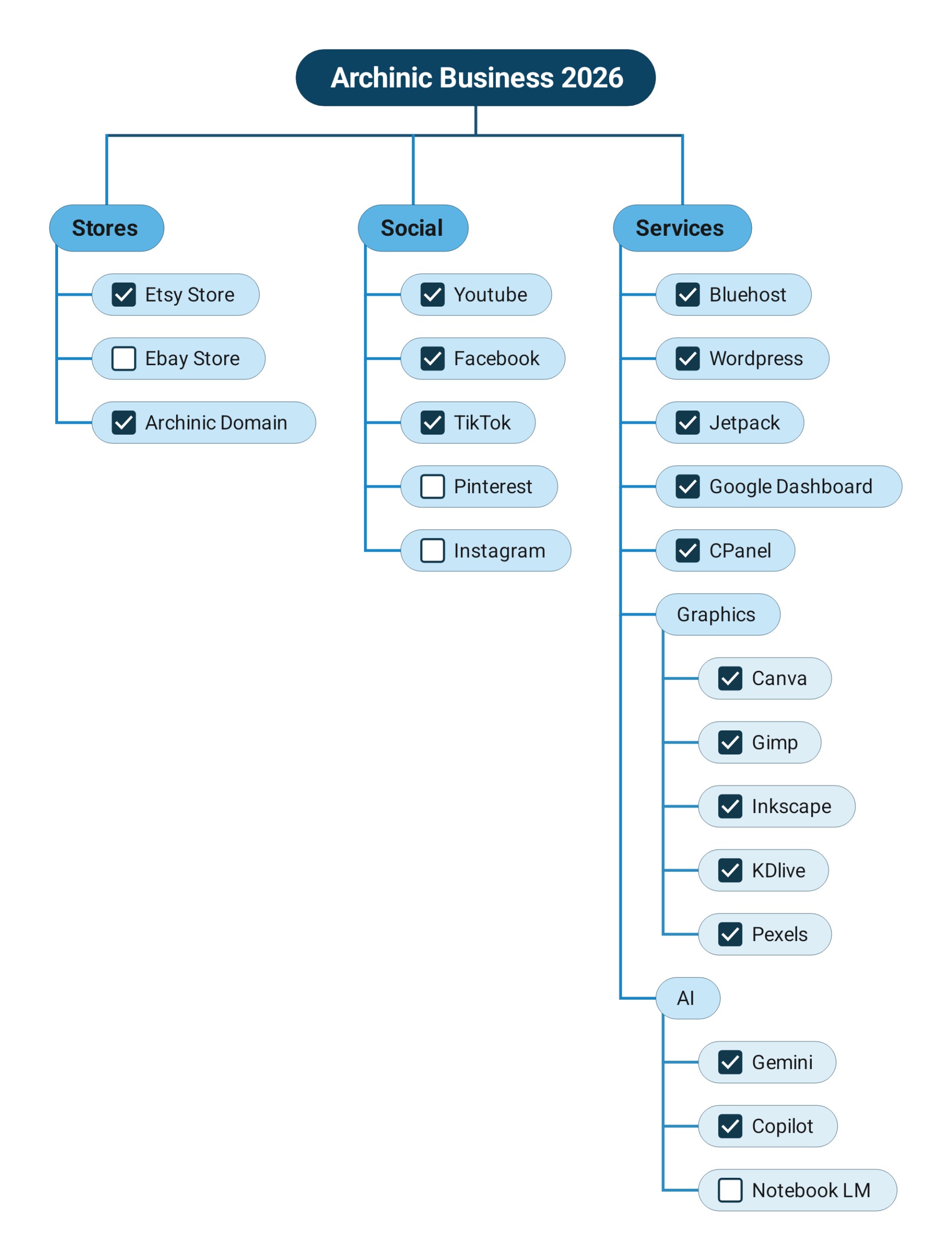
Archinic Designs, like any growing business, needs a solid business plan. Below is a brief overview of how I’m approaching that process. Since I’m a visual thinker, I started by creating a mind map to capture what’s already been completed and what still needs attention. I’ve included that map below. And yes—the full business plan is still in progress.
A business plan moves your idea from concept to implementation by turning a vision into a structured, evidence‑based roadmap. Below is a concise brief that walks through the full process, grounded in authoritative guidance from the U.S. Small Business Administration (SBA) and leading planning frameworks.
Business Plan Core Takeaway
A strong business plan clearly defines your concept, validates it through market and financial analysis, and outlines the operational steps needed to launch and grow. It is both a strategic blueprint and a tool to secure funding.
From Concept to Implementation: A Structured Brief
1. Define the Concept
Your concept is the foundation of the plan. It should articulate:
What your business does
The problem it solves
What makes it unique (your value proposition)
This aligns with the “Concept” pillar of the 3 Cs framework.
2. Understand Your Customer
Conduct market research to identify:
Target demographics and behaviors
Market size and trends
Competitor landscape
Precise customer definition strengthens your entire plan and demonstrates credibility to investors.
3. Validate Feasibility
Before writing the full plan, validate:
Demand for your product/service
Competitive advantage
Startup costs and pricing feasibility
This step helps uncover blind spots early—something experienced reviewers consistently see as critical.
4. Choose a Plan Format
Two common formats:
Traditional plan — detailed, often 15–25 pages, preferred by lenders/investors
Lean startup plan — concise, 1–2 pages, ideal for early-stage idea testing
Both formats follow standard structures recognized by the SBA.
5. Write the Business Plan
A complete plan typically includes:
Executive Summary — one-page overview of concept, market, financials
Company Description — mission, vision, legal structure
Products/Services — offerings, pricing, customer experience
Market Analysis — data-driven insights on customers and competitors
Organization & Management — team, roles, advisors
Marketing & Sales Strategy — channels, messaging, customer acquisition
Funding Request — how much you need and why
Financial Projections — revenue forecasts, expenses, break-even analysis
Appendix — supporting documents
These sections align with SBA and industry-standard expectations.
6. Plan Startup Costs & Funding
Estimate:
Equipment, inventory, and operating expenses
Working capital needs
Funding sources (loans, investors, grants, personal capital)
Accurate cost planning is essential for investor confidence.
7. Prepare for Implementation
Translate the plan into action:
Set milestones and timelines
Build operational processes
Establish marketing campaigns
Leave a Reply